
It’s usually the first question
What size tank do I need? It’s a reasonable question with a lot of variables behind it, and the honest answer is: it depends.
Buy too small and you’ll run dry over summer. Buy too large and you’ve spent more than your site or budget warrants. The right size comes down to how much water you can collect, how much you actually use, and what you need the tank to do.
Work through the following and you’ll have a clear idea of what you need.
Start with what you need the water for
Purpose is the most practical place to start because it gives you a target volume.
Garden irrigation only: a 5,000 to 10,000 litre tank is usually enough for a suburban backyard. You’re not supplementing the household, just keeping the garden going between rain events.
Household supplement (toilet flushing, laundry, garden): you’re looking at 10,000 to 22,500 litres for a typical family home. This reduces mains water demand without draining the tank completely between fills.
Full household use including drinking water: this is where storage capacity matters most. Most rural households running entirely on tank water keep 22,500 litres or more on hand to cover dry periods.
Fire water storage: fire tanks are sized to your site and risk level, and need a dedicated pump and outlet. If this is part of your planning, get in touch and we’ll work through the right setup with you.
How much water can your roof collect?
Your roof is your catchment. To estimate what you can realistically collect in a year, you need two numbers: the plan area of your roof (length × width, not the slope) and your local annual rainfall.
Annual yield (litres) = catchment area (m²) × annual rainfall (mm) × 0.8
The 0.8 accounts for practical losses: evaporation and the initial flush at the start of a rain event before collection kicks in.
As an example, a 150m² roof in a location that receives 800mm of rain per year can yield around 96,000 litres annually. That’s enough to fill a 22,500L tank four times over, assuming the rain comes at useful intervals.
Check your local rainfall figures at bom.gov.au. Annual averages are a useful starting point, but distribution matters as much as the total. If most of your rainfall arrives in winter and you need water through summer, your tank has to carry you through several dry months, not just a few weeks.
How much water does your household use?
The average Australian uses around 200 litres of water per day. For a family of four, that’s roughly 800 litres a day or about 290,000 litres across the year.
If you’re using tank water as a supplement alongside mains, your actual draw on the tank will be much lower. But if you’re running entirely on rainwater, these numbers tell you how long your storage will last between rain events.
A 22,500L tank serving a family of four gives you around 28 days of buffer at full household usage. Most rural properties plan for 60 to 90 days between significant rain, which is why 45,000 litres and above is common in those situations.
Space on your property
Tank volume and footprint don’t always line up neatly, particularly on suburban blocks or sites with limited access.
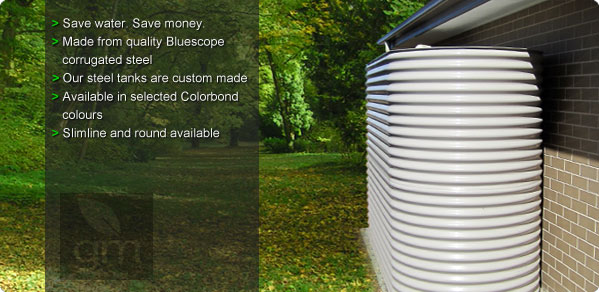
This is one of the practical advantages of a custom-built corrugated steel tank. We manufacture tanks in almost any diameter and height combination, so the tank fits your site rather than you compromising around a standard poly size. A taller, narrower profile stores the same volume in a smaller footprint. A lower profile suits sites where height is an issue.
A quick reference to get you started
These ranges cover the most common scenarios:
- Suburban block, garden use only: 5,000 to 10,000 litres
- Suburban block, household supplement: 10,000 to 22,500 litres
- Rural property, household use: 22,500 to 45,000 litres
- Rural property, household and stock: 45,000 litres and above
- Fire water storage: contact us for site-specific sizing
These are starting points, not fixed rules. The best way to land on the right size is to tell us your roof dimensions, your location, and what you need the water for. We’ll take it from there.
Get in touch with the gmTANKS team to talk through the right setup for your property.