
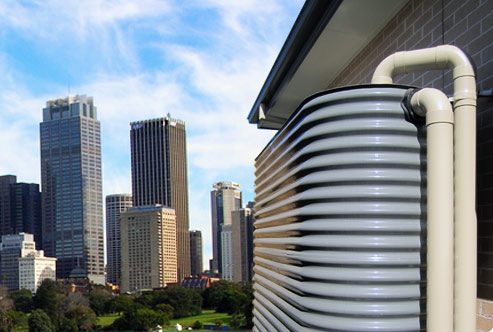
Round water tanks are the go-to for a reason. They’re efficient, they hold a lot of water, and they’ve been around long enough that most people know exactly what to expect. But round tanks need space, and not every property has it.
Side setbacks, narrow runs alongside a house, tight courtyard corners, decks built over bare ground, these are the situations where a slimline tank earns its place. They’re designed for exactly that: to fit where a round tank won’t.
If you’re looking at a slimline tank for the first time, here’s what you actually need to know before you commit.
What is a slimline water tank?
A slimline tank is a water tank with a narrow profile, typically rectangular or squareline in shape. Where a standard round tank might be 1.5m to 2.5m in diameter, a slimline tank is usually between 500mm and 800mm wide, designed to run parallel to a wall, fence, or building.
They’re available in a range of heights and lengths, which is where the real flexibility comes in. A taller, longer tank holds more water while keeping the footprint narrow. A shorter, squatter version suits areas with height restrictions, like under a deck or alongside a boundary fence with an overhanging structure.
At gmTANKS, all of our slimline tanks are made from BlueScope Aquaplate steel. That’s the same food-grade coated steel used across our full range: certified safe for drinking water, built to handle the Australian climate, and significantly more durable than a poly tank over the long term.
When does a slimline tank make sense?
The straightforward answer is: when you need water storage and a round tank won’t fit. But it’s worth thinking through the specific situations where slimline tanks work well.
Narrow side access. The most common use case. The gap between a house and the boundary fence is often 600mm to 900mm, which rules out most round tanks. A slimline tank can run the full length of that space, capturing significant volume without taking up any usable yard.
Under a deck or pergola. Height matters here as much as width. A lower-profile slimline tank can sit under an existing deck, keeping storage out of sight and making use of otherwise dead space. You’ll need to check clearances and plan for overflow and inlet positioning, but it’s a clean solution on the right property.
BASIX compliance in tight blocks. NSW BASIX requirements mandate a minimum rainwater storage volume for new builds, but many urban and semi-urban blocks don’t have the space for a traditional round tank. A slimline tank, or a pair of them linked together, is often the most practical way to meet the requirement without sacrificing usable outdoor space.
Alongside garage walls or sheds. Slimline tanks sit flush against structures well, which makes them easy to hide behind landscaping or paint to match the building. They can also be positioned directly under a downpipe with minimal plumbing.
How much water does a slimline tank hold?
More than most people expect, once you account for the length. A slimline tank that’s 600mm wide, 1.8m tall, and 3m long will hold around 3,000 litres. Extend that to 5m and you’re looking at 5,000 litres or more.
Because gmTANKS manufactures to order, you’re not locked into a catalogue of fixed sizes. If the gap on your property is 4.2m long and 650mm wide, we can build to that. Custom sizing is the point. You give us the space you have, and we work backwards from there.
For properties where a single slimline tank won’t hit the volume you need, two tanks can be linked using a common inlet, so they fill simultaneously and function as a single storage system.
What to look for before you buy
A few things are worth confirming before you commit to a slimline tank, regardless of who you buy from.
Material. Steel or poly are the two main options. Steel tanks (particularly Aquaplate) last longer, maintain water quality better over time, and handle UV exposure without degrading. Poly tanks are cheaper upfront, but they become brittle in direct sun and can develop a taste in the water over time. If the tank is going somewhere exposed, steel is worth the difference.
Actual dimensions versus the listed capacity. Tank capacity is sometimes calculated to the brim, not to the practical fill level. Check the dimensions of the tank against your available space, and confirm the overflow height if the tank is going somewhere that drainage matters.
Inlet and outlet positioning. This affects where the tank can sit and how it connects to your downpipes and pump. A tank manufacturer who builds to order can position these to suit your setup. An off-the-shelf tank has fixed positions, which sometimes means awkward plumbing work to compensate.
Colour. A slimline tank is often more visible than a round tank tucked into a back corner. gmTANKS tanks are available in any Colorbond colour, so they can match your fence, gutters, or cladding, rather than sitting out as an obvious afterthought.
Delivery and installation. A long slimline tank can be awkward to manoeuvre through a side gate. Worth checking the access before you order, and confirming what delivery involves.
How to get a quote
The easiest way to figure out what will work for your property is to send us your space and what you’re trying to achieve. We can advise on sizing, configuration, capacity, and colour, and give you a quote based on an actual custom build rather than the closest available standard size.
Get in touch with the team at gmTANKS to talk through what you need, or get a quote.